Many 4S stores under American Express have been complained that they have delayed the delivery of new cars.

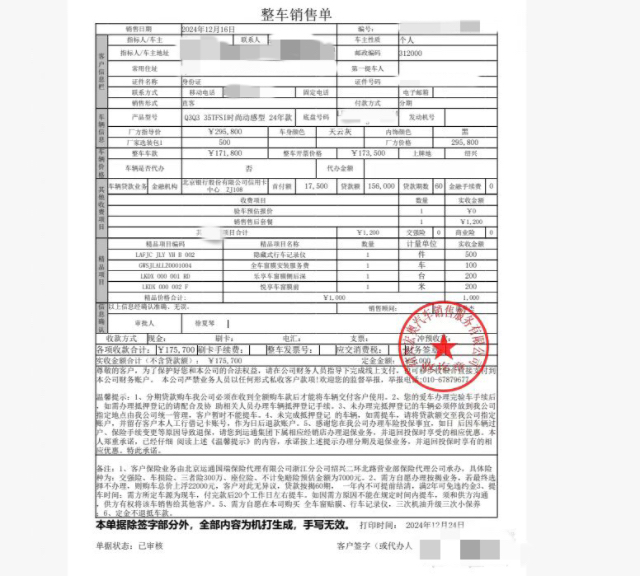
  In December 2024, Mr. Qiu bought an Audi Q3 in Shaoxing Hongao Automobile Sales & Service Co., Ltd. (hereinafter referred to as "Shaoxing Hongao 4S Store") by way of mortgage loan, and both parties agreed to pick up the car on January 20, 2025. But until now, Mr. Qiu has not mentioned the new car.

  "I have already paid off three car loans, but the 4S shop has been delaying the date of picking up the car. The staff said that the new car certificate was mortgaged.However, the owner’s car purchase money was taken away by the headquarters for other purposes, and the 4S shop had no money to redeem the new car certificate. "Mr. Qiu told the First Financial Reporter.

  Shaoxing Hongao 4S Store belongs to the North.Guorong Investment Group Co., Ltd. (hereinafter referred to as "Yuntong Automobile"), the reporter noticed that many 4S stores under Yuntong Automobile, such as Beijiao, Shaanxi Yuntong Ruidi and Shaoxing Hongao, had consumer complaints about delayed delivery of new cars and unauthorized deduction of user points, involving Land Rover, Audi and other brands.

  At present, the owners of Yuntong Auto in Hangzhou, Shaoxing and Wenzhou have established rights protection groups, with nearly 200 people, and consumers have filed lawsuits in court.

  A number of employees of Chongqing Yuntong Shengdi, a subsidiary of Yuntong Automobile, told reporters that they were owed wages. "As early as July 2023, part of the performance salary was not paid, and then in 2024, the salary was not paid for two months, but the social security provident fund was paid normally. Because I can’t afford the waiting time, I have already gone through the resignation procedure. " An employee said. The video he provided shows that the exhibition car of Chongqing Yuntong Shengdi Store has been emptied, and only the maintenance service is reserved.

  According to the enterprise investigation information, Chongqing Yuntong Shengdi Automobile Sales & Service Co., Ltd. currently has seven contract disputes with security service companies and construction companies, and the shareholder Chengdu Yuntong Guorong Investment Co., Ltd. was listed as the executor by the court.

  In view of the above situation, China Business News reporter failed to contact American Express for comment by telephone or email.

  Wang Youyin, a senior partner of Beijing Shengyun Law Firm, told reporters that consumers should first complain and report to the relevant administrative organs through formal channels when they encounter the default of selling cars by Express, and they can report problems to market supervision and management departments, consumer associations and other institutions. The second is to sue and seal up the other party’s property to protect their own rights and interests. In the course of litigation, consumers can apply to the court for seizure, freezing and other preservation measures to ensure that the judgment can be effectively enforced.

  It is worth noting that according to official website Information of American Express Automobile, the company is mainly engaged inBrand cars, including, Bentley,, Lamborghini, Mercedes-Benz, Lincoln, Audi, BMW, Jaguar Land Rover, British finidi, etc. The number of brand stores accounts for 86% of the total number of the group. According to the china automobile dealers association report, dealers who mainly sell fuel vehicles have increased their operating pressure in the past year. In 2024, the profit ratio of automobile dealers was 39.3%, the flat ratio was 19%, and the loss ratio was 41.7%. In February this year, the inventory coefficient of high-end and imported car brand dealers was 1.85, up 58.1% from the previous month.

  Since last year, Baolide Automobile,Luxury brand dealers have experienced business problems such as delaying the delivery of new cars. China grand auto Group’s Heilongjiang Zunrongjie Road Land Rover 4S Store issued a notice of suspension of business, saying that due to china grand auto’s transfer of 4S store funds, Jaguar Land Rover manufacturers refused to give wholesale resources, and the company did not pay wages for many months, which eventually led to the break of the capital chain and made it difficult to operate, and decided to suspend business on December 5 last year. In addition, in the second half of last year, BMW 4S stores in Beijing, Fuzhou and Xiamen were exposed and closed, and the delivery of new cars was delayed. BMW Group announced that it had cancelled its contract with G.A. Group, a Singapore automobile dealer group affiliated to the 4S store, and cancelled its authorization.

  Lang Xuehong, Deputy Secretary-General of china automobile dealers association, said that the competition in the automobile market has become more and more fierce, and manufacturers and dealers have adopted the strategy of "exchanging price for quantity" and spared no effort to compete for market share, resulting in the situation of no increase in revenue and no increase in profit, and the price inversion of most brands has intensified. In 2024, 60.4% of car dealers’ prices were upside down by more than 15%. The serious price inversion has swallowed up the liquidity of dealers, and the tight liquidity has become a difficulty for automobile dealers.

Jiangsu Provincial People’s Government Office (Office) Document Notice of the General Office of the Provincial Government on Printing and Distributing Jiangsu Provincial Highway Network Planning (2011


  Su Zhengban made [2012] No.188



  General Office of the Provincial Government on Printing and Distributing Jiangsu Province


  Notice of Provincial Highway Network Planning (2011-2020)


Municipalities, counties (cities, districts) people’s governments, provincial committees and offices, and provincial directly affiliated units:


  "Jiangsu Provincial Highway Network Planning (2011-2020)" has been approved by the provincial people’s government and is hereby issued to you, please earnestly organize its implementation.


General Office of Jiangsu Provincial People’s Government


November 5, 2012


    Planning of Provincial Highway Network in Jiangsu Province


  (2011-2020)


  As an important part of the comprehensive transportation system, provincial highway network is an important infrastructure guarantee for the economic and social development of our province. Since 2003, under the guidance of the Notice of the General Office of the Provincial Government on Forwarding the Adjustment Plan of Provincial Highway Network in Jiangsu Province of the Provincial Communications Department (Su Zhengban [2003] No.5, hereinafter referred to as the Adjustment Plan), after nearly 10 years of efforts, the provincial highway network in our province has made great progress in terms of total scale and service capacity. By the end of 2010, the total mileage of national and provincial highways in the province reached 12,989 kilometers, including 4,825 kilometers of national highways (2,783 kilometers of national highways and 2,042 kilometers of ordinary highways) and 8,164 kilometers of provincial highways (1,263 kilometers of expressway and 6,901 kilometers of ordinary highways), and the planned route of the Adjustment Plan was basically completed. At present, the national highway and provincial highway network in our province has undertaken more than half of the total road traffic in the province. The implementation of "Adjustment Plan" has greatly eased the pressure of highway transportation in our province, effectively improved the level of road network service and security, strengthened regional ties, improved the investment environment, and effectively promoted the sustained and healthy economic and social development of our province.


  In the coming period, our province will take promoting scientific development and building a beautiful Jiangsu as the theme, accelerating the transformation of economic development mode as the main line, highlighting the drive of innovation, fully implementing the "six stresses", fully implementing the "eight projects", promoting the "two firsts" well and quickly, and constantly creating a new situation of scientific development. Therefore, it has become an urgent task to build a modern comprehensive transportation system with reasonable layout, perfect functions, smooth connection, safety and high efficiency to guide and support economic and social transformation and development. Under the background of the continuous improvement of urbanization level, continuous adjustment and optimization of industrial structure, accelerated construction of comprehensive transportation system and Jiangsu coastal development becoming a national strategy, it is necessary to proceed from the needs of long-term economic and social development, scientifically plan the rational layout of provincial highway network, guide the scientific development of trunk highway network, and fully meet the needs of building a well-off society at a higher level in an all-round way and taking the lead in basically realizing modernization.


  First, the necessity and urgency of planning


  (A) is to meet the needs of economic and social modernization in Jiangsu Province.


  The 12th Party Congress of the whole province clearly stated that in 2015, Jiangsu will build a well-off society at a higher level in an all-round way, and places with conditions such as southern Jiangsu will take the lead in basically realizing modernization. After five years of hard work, by 2020, the whole province will basically realize modernization, reaching the level of moderately developed countries as a whole. Such a development mode and speed will inevitably lead to the upgrading of the total flow of personnel and materials in the whole society. As the backbone of supporting economic development and undertaking social transportation demand, the trunk highway network composed of national highways and provincial highways must adhere to the principle of "overall development, local conditions and classified guidance" to further improve its network capacity and service level.


  With the comprehensive promotion of the integration strategy of the Yangtze River Delta, the economic and industrial ties between our province and neighboring provinces and cities will be closer, and it is necessary to further strengthen inter-provincial transportation services and support and guarantee capabilities. With the comprehensive promotion of the "four-edge" strategy of industrial development in our province, especially in the context of Jiangsu coastal development becoming a national strategy, the "four-edge" pattern of industrial layout in the province will be further strengthened in the future, and the industrial division of labor along the transportation corridor will be more refined and the industrial cooperation will be closer, which will induce a large number of channel traffic demand. At present, some highway transport corridors have shown obvious traffic tension, and it will be difficult to meet the traffic demand induced by industrial upgrading in the future.


  At present, there are 139 national and provincial development zones in our province. In the coming period, the innovation-driven strategy implemented by our province will further guide the transformation of economic development mode. As the main position of innovation implementation, new economic gathering points with various economic development zones, high-tech industrial bases and logistics parks as the main body will emerge continuously. Highway transportation is the most convenient, flexible, fast and efficient among various modes of transportation. However, the national highways and provincial highways in our province have not been able to fully connect or cover the above-mentioned economic agglomeration points, especially some newly established national or provincial development zones in recent years. Therefore, it is urgent to change the status quo in order to further enhance the service guarantee role of transportation in economic transformation and upgrading.


  (2) It is the need to effectively protect and improve people’s livelihood.


  At present, China is in a period of social transformation, and the rapid improvement of urbanization level is one of its main characteristics. According to the forecast, the proportion of urban population in Jiangsu will exceed 65% by 2020. The spatial pattern of urban and rural areas in the province will undergo profound changes, the development speed of large and medium-sized cities will gradually accelerate, the scale and grade of cities will steadily increase, the number of small and medium-sized cities will increase significantly, and the urbanization process will enter a period of comprehensive accelerated development.


  With the development of urbanization, the characteristics of highway transportation will change obviously. On the one hand, the frequency of short-distance travel within the city and between cities is increasing, and the demand for flexible travel such as tourism, leisure and visiting relatives and friends is increasing rapidly. On the other hand, the phenomenon of highway "market town" will become more and more serious, and transit traffic and internal traffic in cities and towns will interfere with each other, which will affect highway traffic efficiency and urban and rural residents’ travel.


  According to the requirements of the Ministry of Transport, the construction of toll road system with expressway as the main body and non-toll road system with ordinary road as the main body will become the future development direction of highway traffic in China. Ordinary highway is a non-toll highway that provides basic universal services for public travel. It is the transportation infrastructure with the widest coverage, the largest population, the most common service and the strongest public welfare in China, and it is an important basic condition for ensuring economic and social development and people’s production and life. In the important period of social transformation in our province, we should guide the rapid development trend of urbanization with the concept of moderate advancement, constantly optimize the national and provincial highway networks, especially the highway networks serving the rapidly urbanized areas, improve the overall coverage and service level of the highway networks, realize public welfare basic services, and further improve people’s livelihood.


  (3) It is the need to improve and upgrade the comprehensive transportation system.


  The coming period will be an important period for our province to accelerate the construction of modern comprehensive transportation system. During the "Twelfth Five-Year Plan" period, we will focus on optimizing the transportation structure, strengthening the coordination between various modes of transportation, between urban and rural transportation and between intercity transportation, highlighting the construction of comprehensive transportation corridors and hubs and the construction of Jiangbei railway network, taking the lead in basically realizing the modernization of transportation infrastructure, and basically forming a comprehensive transportation system with reasonable layout, perfect functions, smooth connection, safety and efficiency.


  The construction of modern comprehensive transportation system will bring about changes in the overall transportation structure of the whole province. Long-distance highway and bulk passenger and cargo transportation will be transferred to a certain extent, and the demand for short-distance distribution between highways and various comprehensive transportation hubs will continue to increase. Therefore, it is necessary to re-examine the function and role of highway transportation from the perspective of comprehensive transportation. As the backbone of the highway network, the national highway and provincial highway network should highlight the advantages of network coverage, focus on filling the gaps and weak areas served by other modes of transportation, connect all kinds of important comprehensive transportation nodes, strengthen the connection and cooperation of multiple modes of transportation, realize complementary advantages, and accelerate the construction of comprehensive transportation system.


  According to the plan, the expressway network in our province will be basically completed during the "Twelfth Five-Year Plan" period, which can meet the transportation needs of important passages together with other modes of transportation such as railways. However, at present, the connection between expressway and ordinary highway is not smooth enough, and nearly 50% of interchanges lack high-grade highway connection or poor maintenance and management of connecting roads, which need to be improved and give full play to the overall transportation efficiency of highway network. In addition, compared with developed countries (regions), the scale of national highways and provincial highways in our province is still insufficient. At present, national highways and provincial highways in our province account for 3.2% and 5.4% of the total highway mileage respectively, while those in Japan are 5.2% and 10.7%, those in the United States are 5.4% and 5.9%, and those in Taiwan Province are 2.3% and 11.7%. The mileage of national highways and provincial highways in our province is relatively low, especially the mileage of ordinary provincial highways is relatively small. In 2010, the total mileage of national highway and provincial highway network in our province was 12,989 kilometers, which took up 50.9% of the total highway traffic with 8.6% of the highway mileage, and the contradiction between travel supply and demand remained outstanding. Therefore, the highway network structure in our province still needs to be continuously improved, and the proportion of provincial highway network needs to be improved urgently.


  In 2010, the number of civilian cars in our province was 5.677 million, with an average annual growth rate of 19.7% during the Eleventh Five-Year Plan period. In the next 10 years, the number of cars will continue to grow steadily, and it is expected to reach 14.725 million in 2020, 2.6 times that of 2010. With the acceleration of the automobile era, the carrying capacity of the future highway network is facing great challenges. Planning provincial highway network and considering the long-term layout, reasonable structure and construction of trunk highways in our province are effective ways to solve the shortage of highway network capacity.


  (4) It is necessary to strengthen the management and maintenance of trunk highways.


  The implementation of the reform of refined oil taxes and fees has fundamentally changed the sources of funds for highway traffic development. This reform requires the overall arrangement of highway construction and maintenance funds to realize the optimal allocation and rational utilization of resources, which has a far-reaching impact on highway infrastructure construction, maintenance and industry management.


  In order to support the development of ordinary highways, the Notice of the General Office of the State Council on Forwarding Several Opinions of the Ministry of Transport of the Ministry of Finance of the Development and Reform Commission on Further Improving Investment and Financing Policies to Promote the Sustainable and Healthy Development of Ordinary Highways (Guo Ban Fa [2011] No.22) clearly points out that it is necessary to study and establish a long-term investment and financing mechanism based on public finance, with clear responsibilities of governments at all levels and matching financial resources and powers.


  After years of practice, our province has accumulated rich experience in the maintenance and management of national and provincial highways, with a relatively high level of maintenance and a relatively good road condition and service level. However, due to the small scale, the overall service capacity of the entire highway network is limited. In recent years, a number of local highways with higher grades and longer mileage have been built in various parts of the province, which have actually assumed the function of provincial roads and played a greater role in the economic and social development of various places. However, this part of the road has a low administrative level and a low level of management and maintenance. Therefore, from the perspective of improving the overall efficiency of the road network and maintaining the stock resources, by compiling the overall and long-term provincial road network planning, the future development scale and scientific layout of the provincial road network in our province can be planned as a whole, and the local roads that undertake the provincial road function can be included in the provincial road network, which is the basis for ensuring the high-standard management and maintenance of the provincial road network in our province, and also the basis for establishing and improving the long-term investment and financing mechanism that matches financial resources and powers, and strengthening the sustained and healthy development of Jiangsu’s highway traffic security economy and society.


  To sum up, doing a good job in the planning of provincial highway network in our province is an important measure to adapt to the new changes in economic and social development, the development of transportation in the new period, and the need to strengthen the maintenance and management of trunk highways. It is of great significance to promote the comprehensive, coordinated and sustainable development of highway traffic in Jiangsu and further safeguard and improve people’s livelihood.


  Second, the traffic demand forecast


  (1) Distribution characteristics of passenger and cargo flows.


  Generally speaking, the steady development of the province’s economy and society will bring about the rapid growth of road traffic in the province, and the acceleration of the integration process of the Yangtze River Delta will further promote the exchanges between Jiangsu and neighboring provinces and cities, while the improvement of the comprehensive transportation system will gradually reduce the proportion of long-distance road transit traffic. By 2020, the proportion of internal flow, entry-exit flow and transit flow of highway traffic will change from 59:36:5 in 2010 to 63:34:3.


  In the future, the links between central Jiangsu, northern Jiangsu and southern Jiangsu will be closer, the passenger and cargo traffic volume in the vertical passages in the province will continue to grow steadily, and the traffic pressure across the river will further increase. Shanghai-Nanjing, coastal areas, along the Yangtze River and East Longhai are the main channels of passenger and cargo flow in the province, among which Shanghai-Nanjing channel will remain the busiest road transport channel in the province, mainly undertaking high-frequency, fast intercity passenger transport and high value-added and high-timeliness cargo transport; The growth rate of passenger and cargo flow along the coastal and riverside passages will be the fastest; The East Longhai Passage will become the main road transport passage radiating from Jiangsu coastal areas to the central and western regions of the country.


  (2) The growth trend of traffic volume.


  In the future, the traffic volume of national highway and provincial highway network will show a rapid growth trend. In 2020, the total traffic volume of national highway and provincial highway network in the province will increase to 595.28 million vehicles. Km/day, the average traffic volume will increase to 18,128 vehicles/day, 2.2 times and 1.3 times that of 2010, respectively, which puts forward higher requirements for the overall scale and technical level of national and provincial highway networks.


  In the future, the traffic volume of the road network in southern Jiangsu, central Jiangsu and northern Jiangsu will still increase gradually from north to south, but the gap will gradually decrease. Among them, the average traffic volume of national highway and provincial highway network in southern Jiangsu will increase from 19,425 vehicles/day in 2010 to 23,205 vehicles/day in 2020, reaching the technical standard of 4-6 lane first-class highway; The number of vehicles/day in central Jiangsu increased from 10920 to 16905, reaching the technical standard of four-lane first-class highway; Northern Jiangsu increased from 9773 vehicles/day to 13901 vehicles/day, which is close to the technical standard of four-lane first-class highway. The difference of regional traffic trips requires the formulation of differentiated development policies to realize the coordinated development of highway traffic infrastructure in various regions.


  (3) Characteristics of traffic volume generation and change.


  Highway transportation will enter the stage of rapid growth of passenger transportation characterized by "personalized transportation" and freight transportation characterized by "more batches and less batches".


  With the sustained and rapid economic growth and the sustained and rapid development of the automobile industry, the income and consumption level of residents have improved significantly. During the "Eleventh Five-Year Plan" period, the number of civilian cars in our province increased by 19.7% annually. In the next 10 years, the number of cars will continue to grow steadily, the proportion of car trips will continue to increase, and passenger trips will be diversified, high-level and unevenly distributed in time and space. Residents’ travel frequency and travel distance will greatly exceed the existing level, and intercity traffic, business travel and commuting traffic will be more frequent, which will also put forward higher requirements for comfort, convenience and safety of travel.


  The average value of road transport goods will be significantly increased, while the average volume and tonnage will gradually decrease, and the growth rate of total transport demand will be slowed down, but the demand for transport service quality will be higher. The demand for freight with many batches, small batches, high value, strong timeliness and high dispersion will be greatly increased, and the demand for short-and medium-distance distributed transportation will be obviously accelerated, and it will gradually become the main demand for road transport. According to the forecast, in 2020, the passenger traffic, passenger turnover, freight volume and cargo turnover of the whole society will reach 4.7 billion passengers, 263.3 billion person-kilometers, 2.8 billion tons and 264.3 billion ton-kilometers, respectively, which are 2.2 times, 2.2 times, 2.3 times and 2.3 times that of 2010.


  III. Guiding ideology and planning principles


  (1) Guiding ideology.


  Guided by the implementation of Scientific Outlook on Development, with the aim of serving the overall strategy of "two firsts", with the starting point of ensuring and improving people’s livelihood, with the main line of accelerating the transformation and development of the highway industry, we will make overall planning and rational layout, promote the construction of an integrated transportation system, effectively reduce logistics costs, better meet the people’s increasing travel needs, fully support the two national strategies of Yangtze River Delta integration and coastal development, and continuously promote the sound and rapid economic and social development of the province.


  (2) Planning principles.


  1. Overall planning. Resolutely implement the strategic guidelines established by the state and the province, obey the overall goal of economic and social development, obey the province’s industrial layout and urban system planning, and obey the national highway network planning.


  2. Moderately ahead. Adhere to the development concept of "planning leading and moderately ahead", adapt to the needs of building a well-off society in an all-round way and basic modernization, fully consider the long-term development needs of highway transportation, and give full play to the supporting and guiding role of highway transportation infrastructure in economic and social development.


  3. Coordinated development. Ensure regional coordinated development, promote the integration of highway transportation networks between southern Jiangsu and central Jiangsu and northern Jiangsu, adhere to local conditions, and form a provincial highway network that is suitable for the economic and social development level of each region. Pay attention to the connection with other modes of transportation and the road networks of neighboring provinces and cities, and give full play to the overall benefits of the comprehensive transportation system.


  4. Green development. Adhere to the development of highway network, pay equal attention to intensive use of resources and protection of ecological environment, and realize the low-carbon development and green development of highway network in the whole province under the condition of affordable resources and environment.


  5. Pay attention to efficiency. Adhere to the adaptation of supply and demand, comprehensively analyze the regional differences, formulate differentiated development goals, reasonably determine the road network layout, construction level and construction sequence, and improve the road network operation efficiency.


  (3) Planning objectives.


  The planning goal of provincial highway network is to adapt to economic and social development and transportation needs, cover all cities, counties (cities, districts), key central towns, development zones above the provincial level and scenic spots above 4A level, connect major port areas, airports and large railway freight yards, and realize coordinated development with other modes of transportation. By 2020, Jiangsu provincial highway network with clear functions, reasonable structure, appropriate scale, smooth connection and efficient management will be formed, basically reaching the level of moderately developed countries.


  Fourth, functional level and scale demonstration


  (1) Functional level.


  According to the theory of highway function classification, combined with the actual situation of highway development in our province, the national highway and provincial highway are divided into three levels: expressway trunk, expressway trunk and general trunk. Expressway trunk lines include national expressways and expressway provincial roads. Expressway trunk lines are ordinary national roads and main provincial roads connecting neighboring cities and counties (cities, districts), and the rest are ordinary trunk lines.


  1. High-speed trunk line. Expressway is the main skeleton of the highway network in the province, which mainly serves the medium and long-distance expressway traffic between provinces, among the three metropolitan areas in the province and in the main transportation channels in the province, connecting provincial capitals, cities under the jurisdiction of the province, counties (county-level cities) and important coastal ports along the Yangtze River, airports and other nodes, providing large-capacity and efficient transportation services, and providing rapid traffic guarantee for dealing with emergencies such as wars and natural disasters.


  2. Expressway. Expressway and expressway jointly form the trunk system of highway network in the whole province, which mainly serves the short-distance highway traffic between provincial cities, between provincial cities and neighboring counties (cities) and between neighboring counties (cities), connects provincial cities, counties (cities), major coastal ports along the Yangtze River, airports, national and provincial development zones and other nodes, and is convenient to connect with expressway, providing high-level rapid transportation services, and forming a reasonable transportation channel with expressway.


  3. General trunk lines. General trunk line is an important supplement to expressway and expressway, which mainly connects important towns, expressway interchanges, scenic spots above 4A level, comprehensive transportation hubs, logistics parks and industrial and agricultural production bases, and is well connected with expressway, mainly providing short-distance distributed transportation services, and further optimizing the layout of trunk road network.


  (2) Scale demonstration.


  Combined with the characteristics of economic, social and highway network development in our province, according to the requirements of sustainable development, and considering the limited resources, the existing restrictions on highway construction funds and the demand of economic and social development for national and provincial highways, five commonly used methods, such as connectivity method, land coefficient method, growth curve method, analogy method and regression analysis method, are selected to predict the reasonable scale of future national and provincial highway networks in Jiangsu Province. By 2020, the reasonable scale of the national highway and provincial highway network in Jiangsu Province will be 20,000-22,000 kilometers.


  V. Layout plan


  (1) Layout principle.


  1. Focus on improving the provincial highway network in the "four-edge" strategic area, with no less than two trunk highways arranged in the passage, strengthening the lateral traffic links in coastal areas, and constructing longitudinal highway passages in coastal areas to effectively support and guide coastal development.


  2. Strengthen the rapid connection between cities in the Yangtze River Delta, strengthen the connection with trunk highway networks of neighboring provinces (cities), focus on improving inter-provincial highway passages, and effectively serve the implementation of the integration strategy of the Yangtze River Delta.


  3. According to the differences between regions, formulate differentiated development goals, build a high-density and high-grade highway network in southern Jiangsu, properly encrypt and steadily upgrade the grade in central Jiangsu, and improve the access roads and properly encrypt the road network in northern Jiangsu.


  4. Covering cities, counties (cities, districts), key central towns, important towns with a population of more than 100,000, development zones above the provincial level and scenic spots above 4A level together with the national highway network, ensuring the rapid and smooth flow of cities and counties, convenient connectivity of counties and towns, and promoting local economic development.


  5. Incorporate highways connecting important expressways into the provincial highway network, strengthen management, improve service level, and give full play to the overall benefits of the highway network.


  6. Strengthen the connection with other modes of transportation such as major port areas, airports and large railway freight yards in the province, and accelerate the construction of a modern comprehensive transportation system.


  7. Coordinate the relationship between provincial highways and urban roads, and incorporate important urban highway around the city into the provincial highway network. In principle, roads within the highway around the city are not regarded as provincial highways.


  8. Make full use of existing roads, incorporate the roads that have been built and actually assume the function of provincial roads into the provincial highway network, and adjust some existing provincial roads that no longer have the function of trunk roads to county, township or city roads. Improve the transportation capacity of important traffic corridors and the overall operation reliability of road network, and promote the intensive development of provincial highways.


  9. Fully consider the needs of national defense combat readiness, strengthen the traffic construction of national defense strategic passages, campaign passages, coastal defense highways and automobile ferry connecting highways, ensure smooth traffic and rapid military operations in wartime, and ensure national defense security.


  (2) Layout process.


  The main ideas and methods of this planning are: taking planning objectives as the direction, layout principles as the basis, layer-by-layer development as the main line, supplemented by single factor analysis, optimizing the route by combining economic and urban layout, traffic location, terrain conditions, environmental conditions, road section importance analysis, traffic demand analysis, urban development analysis, etc., and comprehensively determining the route plan.


  According to the above ideas, this plan is based on the highway network planning and the existing ordinary trunk highway network, and the layout is carried out layer by layer. The specific process is as follows:


  1. Select the planning node. According to the layout principle, this plan selects three kinds of nodes as service objects.


  (1) Urban nodes: guided by the administrative divisions of Jiangsu Province, the coverage includes cities, counties (cities, districts), key central towns and towns with a population of over 100,000, totaling 216.


  (2) Comprehensive traffic nodes: including major airports, port areas, railway stations and expressway interchanges in the whole province, totaling 568.


  (3) Economic nodes: including provincial and national development zones and 4A and 5A tourist attractions, totaling 240.


  Excluding some nodes located in the city and duplicate nodes, the total number of nodes considered in the layout planning is 920.


  2. Expand the route layout layer by layer.


  (1) Current basic road network.


  Based on "Jiangsu Expressway Network Planning" approved in 2006 and "Jiangsu Provincial Highway Network Adjustment Scheme" approved in 2003, combined with the latest urban development planning, local roads are optimized, adjusted or deleted to form a basic road network. The current basic road network totals 9238 kilometers, including 2614 kilometers of expressways and 6624 kilometers of ordinary highways.


  (2) Channel type line.


  On the basis of planning the expressway network and the current national highway and provincial highway network, we will focus on the channel along the Yangtze River, the coastal channel, the Shanghai-Nanjing channel, the East Longhai channel, the Xusu-Huaiyan channel, the Beijing-Shanghai (Yihuaijiang) channel, the Ning Hang channel, the Yancheng-Taizhou-Wuxi (Changzhou) channel and the Ninglian channel, and carry out the layout of channel-type provincial highways. At the same time, we will further optimize and The total length of channel lines is 2574 kilometers.


  (3) Sub-regional routes.


  Taking the city as a unit, according to the layout principle, according to the specific economic development, industrial layout, urban development and construction conditions of each city, and comprehensively considering the connection and coordination between neighboring cities and counties, and taking 91 key central towns in the province as important coverage nodes, the trunk roads within the sub-regional scope are encrypted and laid, with a total mileage of 2557 kilometers.


  (4) Node contact line.


  Taking important comprehensive traffic nodes, important development zones, tourist areas, special areas and large cities as the key coverage nodes at the third level, single factor analysis is carried out respectively to improve the layout of provincial highway network, and together with the channel-type provincial highway and sub-regional provincial highway basic road network, the preliminary road network scheme of this planning is formed.


  Integrated traffic node. Focus on trunk roads connected with coastal ports along the Yangtze River, inland ports, airports and major railway freight yards, and form a highway collection and distribution system with high grade and smooth connection to realize comprehensive transportation integration. The connecting lines of comprehensive traffic nodes total 177 kilometers.


  Expressway interchange. Combing all the completed and under-construction expressways, and considering the interconnection of trunk highways with important functions and large traffic volume into the provincial highway network, so as to improve the function of expressways serving the local economy. The expressway connecting lines are 706 kilometers in total.


  Development zones and tourist attractions. It is considered to incorporate the important highways connected with national development zones, provincial development zones and tourist attractions above 4A level into the provincial highway network, so as to realize the basic functions of highway service economy. The connecting lines of development zones and scenic spots total 438 kilometers.


  Lake area. Jiangsu has a dense water network and many lakes. In order to solve the problem of traveling in lake areas and accelerate the optimal utilization of lake resources, this plan has planned a highway around lakes with development conditions, with a total mileage of 198 kilometers.


  Large city nodes. In order to meet the development needs of rapid urbanization, the connection between provincial highway network and large-scale city nodes is optimized, and the ring road is planned, with a total mileage of 210 kilometers.


  3. Optimize the road network scheme. Based on the preliminary road network of provincial highway, considering the importance of road section and traffic demand, geological and topographic conditions, distribution of environmentally sensitive areas, road network connection, urban planning and other conditions, the preliminary scheme is optimized by local route selection, and the final layout scheme of provincial highway network is formed.


  (3) Layout plan.


  This provincial highway network planning scheme is divided into two parts: expressway and ordinary highway.


  1. Highway and provincial highway. The expressway in the provincial highway network consists of 36 routes, and the layout types are mainly divided into the following three categories:


  The first category: there are 13 north-south lines, such as Changshu-Jiashan Expressway and Yancheng-Jingjiang Expressway, with a total mileage of 1192 kilometers;


  Category II: East-west routes, such as Siyang-Suzhou Expressway and Yancheng-Huai ‘an Expressway, with a total mileage of 1,115 kilometers;


  Category III: There are 14 expressway branches, such as Lianyungang Port North Shugang Expressway and Shanghai-Chengdu Expressway Zhenjiang Branch, with a total mileage of 307 kilometers.


  2. Ordinary provincial highway. Ordinary highways in the provincial highway network are composed of 185 routes, and the layout types are mainly divided into the following six categories:


  Category I: There are four radiation lines, such as Nanjing-Xuzhou and Nanjing-Zhangjiagang, with a planned total mileage of 395 kilometers;


  Category II: North-South lines, such as Lianyungang-Yancheng-Nantong, Huai ‘an-Jiangdu and Yancheng-Wuxi, with a total planned mileage of 5,305 kilometers. Among them, 6 planned national highway lines are reserved, with a mileage of 1399 kilometers;


  Category III: There are 44 east-west routes, such as Yancheng-Huai ‘an-Suqian, Nantong-Taizhou-Yangzhou-Nanjing, with a planned total mileage of 5,589 kilometers. Among them, 8 planned national highway lines are reserved, with a mileage of 1518 kilometers;


  The fourth category: there are 5 loop lines, such as Nanjing Third Ring Road and Taihu Highway, with a planned total mileage of 680 kilometers;


  Category V: 62 expressway interconnection lines with a planned mileage of 782 kilometers;


  Category VI: There are 22 important connecting lines, such as airports and important scenic spots, with a planned mileage of 733 kilometers.


  Through this plan, our province will form a "5 vertical, 9 horizontal, 5-link" expressway skeleton trunk network and a "4-shot, 52 vertical, 48 horizontal, 5-ring, 86-link" ordinary national and provincial trunk highway network.


  (4) Summary of scale.


  1. Scale of provincial highway network. By 2020, the total scale of provincial highway network in our province will be 16,098 kilometers, including 2,614 kilometers of expressway and 13,484 kilometers of ordinary provincial highway. Among the ordinary provincial roads, 6624 kilometers of ordinary provincial roads are planned by the Adjustment Plan of Provincial Road Network in Jiangsu Province in 2003, and 6860 kilometers of ordinary provincial roads are added.


  2. Overall scale of national provincial highway network. After this planning, there are 245 national highways and provincial highways in our province with a total mileage of 21,000 kilometers, including 24 national highways with a total mileage of 4,902 kilometers; There are 221 provincial highways with a total mileage of 16,098 kilometers.


  National highways and provincial highways: 50 in total, with a total mileage of 5,474 kilometers, including 14 national highways, with a total length of 2,860 kilometers; There are 36 provincial highways, totaling 2614 kilometers.


  General national highways and general provincial highways: 195 in total, with a total mileage of 15,526 kilometers, including 10 general national highways, with a total mileage of 2,042 kilometers; There are 185 provincial highways, totaling 13,484 kilometers.


  (5) numbering scheme.


  The number of expressway provincial roads is determined according to the Rules for Naming and Numbering Expressway Networks in Jiangsu Province.


  The numbering of ordinary provincial roads is based on the existing numbering system, and the number type of connecting lines is added. The number of existing ordinary provincial roads remains basically unchanged, and the number of new lines is arranged in sequence after the number of existing ordinary provincial roads according to their direction or type, that is, "old road number, new road number". The numbering rules for ordinary darts are as follows:


  1. The number consists of four digits, including letters and numbers, such as "S123", where "S" reflects the nature of the dart; "123" reflects the direction, type and sequence of lines.


  2 "123": the first digit "1" indicates the direction or type, and the last two digits "23" are the sequence code.


  The beginning of "1" indicates the radial ordinary provincial road from Nanjing, and the existing number has been coded to S124. Therefore, the new line is coded from S125, and the sequence code increases clockwise from the true north direction;


  The beginning of "2" indicates the north-south general provincial highway, and the existing number has been coded to S254. Therefore, the new lines are coded from S255, and the sequence code increases from east to west, where 201-206 are the planned national highway numbers;


  The beginning of "3" indicates the east-west general provincial highway, and the existing number has been coded to S343. Therefore, the new lines are coded from S344, and the sequence codes increase from north to south in turn, among which 301-308 are the planned national highway numbers;


  The beginning of "4" indicates the expressway interconnection line, which is a new numbering type. From S401, the sequence code of the north-south expressway interconnection line increases from north to south, and the sequence code of the east-west expressway interconnection line increases from east to west.


  The beginning of "5" indicates the port and airport connection line, which is a new numbering type, and is compiled from S501, and the sequence code increases from north to south in turn;


  The beginning of "6" indicates the economic nodes and scenic spots connecting lines, which is a new numbering type. It is compiled from S601, and the sequence code starts with the north-south connecting line and ends with the east-west connecting line, increasing from north to south and from east to west in turn;


  The beginning of "0" indicates the loop line, 001-050 indicates the urban loop line, which is numbered one by one according to the urban administrative division code, and 051-099 indicates other loop lines, and the sequence code increases from north to south.


  In view of the fact that the national highway network planning scheme is basically stable at present, in order to facilitate the implementation of the planned provincial highway network in our province in the future, the connection with the planned national highway is fully considered in this plan, and the top 20 sequential codes in the numbers starting with "2" and "3" are used as the transition numbers of the planned national highway.


  (6) Planning effect.


  The provincial highway network and national highway network formed in this plan cover all cities (13) and counties (including county-level cities, districts, 66), provincial and national development zones (139), 5A and 4A tourist attractions (101), airports (9), 89% of townships in the province (including all key central towns, townships with a population of over 100,000 and 699 other townships), 315 expressways, 96 important port areas along the Yangtze River and about 100 important railway stations, serving the province. Provide leading and basic services for Jiangsu’s future economic and social development, support coordinated economic development and industrial transformation, promote the development of key areas such as Jiangsu’s coastal areas, and provide good basic support for building and improving Jiangsu’s modern comprehensive transportation system.


  1. Access to service effect. In terms of network access services, we will achieve "double trunk lines, wide connectivity and full coverage".


  "Double trunk lines": in coordination with the national trunk line network, no less than two national trunk lines and provincial trunk lines will be laid in the important traffic corridors along the Yangtze River, the coast, Shanghai-Nanjing and East Longhai to meet the needs of the "four-edge" development strategy of our province;


  "Wide connectivity": Coastal ports along the Yangtze River, major inland ports, airports, major railway freight yards and expressways are all connected by national highways and provincial highways, so that the comprehensive transportation system can play a better role;


  "Full coverage": the nodes covered by the provincial highway network are extended from the nodes of cities and counties (cities, districts) to all key central towns in the province, so as to better serve local economic development, industrial layout and urban development.


  2. Running time effect. In terms of network running time, Jiangsu provincial highway network will eventually achieve "10 minutes to enter the network, 30 minutes to access, the same day round trip", which can also be expressed as "10-30-1".


  "Access to the network in 10 minutes": All planning nodes will enter the provincial highway network within 10 minutes.


  "30-minute access": access between adjacent planning nodes is within 30 minutes.


  "Same-day round trip": round trip between any two planning nodes in the province within one day.


  VI. Implementation Plan


  (1) General idea.


  According to the overall goal and phased goal of the provincial highway network development, overall planning and phased implementation, based on the development needs of key areas, comprehensive transportation, regional coordination and transportation itself, with capital and land supply as constraints, taking into account the integrity and continuity of the whole social highway network in each planning period, and at the same time, taking into account factors such as traffic construction and development in neighboring areas, the phased implementation plan of provincial highway construction is arranged.


  (2) implementation principles.


  1. Ensure key areas and routes. The arrangement of provincial highway implementation sequence should give priority to ensuring key areas and key routes, and the trunk highways involving key areas and important trunk highways undertaking the skeleton function of regional road network should give priority to construction, giving full play to the supporting and leading role of traffic in economic and social development.


  2. Coordinate regional development. The formulation of provincial highway implementation sequence should fully consider the needs of regional integration development, and the construction timing should be considered as a whole in terms of the main channel in the metropolitan area and the road network connection between neighboring cities and counties to avoid the situation that the construction timing of the same trunk highway between neighboring cities and counties is quite different.


  3. Serving the construction of comprehensive transportation system. The arrangement of provincial and highway implementation sequence should be based on the principle of accelerating the formation of comprehensive transportation system, enhancing the distribution capacity of main passages and the collection and distribution level of large-scale comprehensive transportation hubs, and giving priority to the construction of expressway interconnection lines and trunk roads for collection and distribution of port and station hubs.


  4. Optimize the allocation of capital, land and other resources. Give full consideration to the constraints of capital, land and other resources, reasonably arrange the time sequence and construction plan of highway construction, encourage the use of old roads to broaden and transform, optimize the allocation of resources, and realize the intensive and green development of highway traffic.


  (3) implementation plan.


  By the end of 2010, 1,263 kilometers of the planned 2,614-kilometer expressway have been built and 1,351 kilometers are to be built. The planned mileage of 13,484 kilometers of ordinary provincial roads is 9,897 kilometers, and the mileage of 3,587 kilometers and below is 3,587 kilometers. Expressway provincial roads will be implemented according to the "Jiangsu Expressway Network Planning", and ordinary provincial roads will basically be built into second-class and above highways in 2020.


  The overall construction scale of ordinary provincial roads planned this time is about 6,000 kilometers, including the new construction or reconstruction and expansion of roads with grade III and below and the reconstruction and expansion of roads with grade II and above. According to the static investment, during the period from 2011 to 2020, the planned new reconstruction of ordinary provincial roads will cost about 140 billion yuan, with an average annual investment of about 14 billion yuan. A total of about 160,000 mu of land will be requisitioned for the new reconstruction project.


  Guided by industrial development, regional coordination and comprehensive transportation development strategy, and based on the ranking results of project importance, the comprehensive ranking of planning and construction projects is obtained. The construction period is divided into two stages: 2011-2015 and 2016-2020. Among them, in 2011-2015, we will focus on the development strategy of "Four Sides" and the construction of comprehensive transportation system, mainly focusing on solving the provincial highway construction with the status quo of Grade III and below, and setting up the provincial highway framework; From 2016 to 2020, we will mainly focus on upgrading provincial highways to improve the grade level and traffic capacity of provincial highways in the province.


  (4) the implementation effect.


  By 2020, the province will form a provincial highway network with a total scale of 16,098 kilometers. The provincial highway network and the national highway network together form a trunk highway network of about 21,000 kilometers in Jiangsu. The connectivity of the road network is about 1.96, the area density is about 20.45 kilometers/100 square kilometers, the population density is about 2.68 kilometers/10,000 people, and the economic density is about 16 kilometers/100 million yuan, which will provide a good support for the basic modernization of the province’s economy and society.


  VII. Policies and Measures


  (a) to maintain the seriousness of planning, overall planning and construction.


  The approved provincial highway network planning in Jiangsu Province is an important basis for the road network construction in our province, which should be strictly followed and related planning should be coordinated with it. At the same time, according to this plan, we should study the route scheme of newly built and rebuilt sections as soon as possible, control the route corridor on the spot, implement the land supply, and arrange the implementation plan reasonably to ensure the smooth implementation of the plan.


  (2) Optimize construction standards to achieve green development.


  Overall consideration of provincial highway construction, operation, maintenance and management, adhere to the optimal total cost. Determine a reasonable alignment scheme, scientifically determine the construction scale, do not unilaterally pursue high indicators that do not meet the actual needs and economic capacity, and reasonably establish construction schemes. Do not build new ones that can be rebuilt and expanded by using the old roads, and try to avoid occupying less cultivated land and fertile land for those that really need to be built. Strengthen innovative design and accelerate the development and application of new materials, new processes and new technologies. Firmly establish the concept of green development of highway traffic, adjust measures to local conditions, improve the efficiency of resource use and protect the ecological environment.


  (3) Improve the investment and financing policies and guarantee the funds for construction, management and maintenance.


  Provincial highway network is a public welfare infrastructure, which should be mainly invested by financial funds. City, county (city, district) people’s government as the main body of construction responsibility, specifically responsible for organizing the implementation, the provincial transportation departments to implement industry management, and carry out fixed subsidies. Provincial highway has a high technical level and a large scale of investment in construction, management and maintenance. In order to ensure the sustainable development of provincial highway network, people’s governments at all levels should conscientiously implement the provisions of document No.22 [2011] issued by the State Council, increase the supply of financial funds, stabilize the channels of funds, and ensure the sources of funds for construction, management and maintenance.


  (4) Strengthen industry management and innovate management mechanism.


  Implement People’s Republic of China (PRC) Highway Law, Regulations on Highway Safety Protection and Regulations on Jiangsu Highway, make full use of legal, administrative and economic means, strengthen industry management, improve service level, promote highway information construction, and improve road network safety and operational efficiency. Actively explore new modes of construction, operation, management and maintenance of provincial highway network, and give full play to the benefits of provincial highway network.


File Download and Attachment: Su Zhengban Fa [2012] No.188. doc


How to strengthen international cooperation against epidemic in multi-point outbreak and spread around the world?

  Xinhua News Agency, Beijing, March 26thQuestion: How to strengthen the international cooperation against the epidemic?

  Xinhua News Agency reporters Xiong Feng, Tian Xiaohang, Shen Cheng and Zheng Mingda

  At present, the international COVID-19 epidemic is accelerating. How to deal with this severe challenge is related to the safety of people of all countries and tests the common wisdom of human society.

  At the press conference held by the State Council Information Office on 26th, relevant authorities responded to the hot issues related to international cooperation in fighting the epidemic.

  How is the progress of foreign aid? Four batches have been implemented to assist 89 countries and 4 international organizations.

  Under the situation that the COVID-19 epidemic broke out and spread in many places around the world, it is urgent and crucial to effectively carry out foreign anti-epidemic assistance.

  Deng Boqing, deputy director of China International Development Cooperation Agency, said that at present, China has organized and implemented anti-epidemic assistance to 89 countries and 4 international organizations in four batches, and is now formulating the implementation plan for the fifth batch of assistance.

  From the perspective of aid recipients, it includes countries with serious epidemic situation, countries with weak public health system and epidemic prevention capacity, and some international organizations. From the way of assistance, it includes both medical material assistance and medical technical assistance.

  Deng Boqing said that when China decided to provide anti-epidemic assistance programs, it mainly considered the following factors: first, the severity of the local epidemic, the local medical and health conditions and the lack of medical materials; Second, the specific assistance needs put forward by the countries concerned to China; Third, the China government’s own capabilities.

  "Under the premise of fully ensuring the needs of domestic anti-epidemic work, we have properly formulated the aid work plan based on the principle of doing our best and doing our best." Deng Boqing said.

  "This foreign anti-epidemic assistance is an emergency humanitarian operation with the most concentrated aid time and the widest scope since the founding of New China." Deng Boqing said that leaders of many countries and international organizations thanked China for its help in various forms, and people in many countries praised China on the Internet and shouted "Thanks to China" in the streets.

  At present, the global epidemic is still developing, and China is still at the critical moment of "importing foreign defense and rebounding internal defense".

  "China will continue to provide assistance to relevant countries within its capacity on the basis of its own epidemic prevention and control." Deng Boqing said, "When people gather firewood, the flames are high." As long as the international community is United and forms a joint force, it will certainly be able to overcome the epidemic and safeguard the health and well-being of the people of the world.

  How to participate in international cooperation against epidemic? Share the "China Experience" without reservation

  Since the outbreak of the epidemic, China has actively organized experts to carry out in-depth technical exchanges, provided assistance and technical support to other countries affected by the epidemic, and shared "China experience" without reservation.

  Ceng Yixin, deputy director of the National Health and Wellness Committee, said that National Health Commission compiled a set of technical documents such as the latest diagnosis and treatment plan and prevention and control plan, and shared them with 180 countries and more than 10 international and regional organizations in time; Co-organized with the World Health Organization the "International Briefing on Sharing Experiences in Prevention and Treatment of China in COVID-19"; Nearly 30 technical exchange meetings were held with more than 100 countries and regions through remote video.

  "During the treatment of some patients, whether hormones should be used, when to use them, how much to use, and how long to use them are all very urgent and instructive experiences in clinic." Ceng Yixin said that China also sent anti-epidemic medical experts to Italy, Serbia, Cambodia and other countries to introduce China’s anti-epidemic experience and strategies, and provide guidance and consultation on disease prevention and control, clinical diagnosis and treatment, community management and other aspects in light of local conditions.

  Only by sharing scientific research data, information and achievements can we defeat the global common enemy "novel coronavirus" in the shortest time.

  Xu Nanping, Vice Minister of Science and Technology, said that China shared viruses and virus genome sequences with the world for the first time, and also set up the Global Coronaviomics Data Sharing and Analysis System, the 2019 novel coronavirus Resource Database and the Sharing and Exchange Platform for Scientific Research Achievements in COVID-19. Among them, in 2019, the database of novel coronavirus Resource Library has provided data services for more than 76,000 visitors from 152 countries and regions, and downloaded more than 4 million files.

  Vaccine is the "atomic bomb" to defeat the virus. Xu Nanping said that the five technical routes of vaccine research and development in COVID-19, China have been promoted simultaneously, all of which have international cooperation and are open to the outside world.

  Next, China will continue to promote the sharing of scientific research achievements. Xu Nanping introduced that China should "publish the results of early clinical trials as soon as possible, and communicate with international counterparts, so that everyone can avoid detours".

  How to care for and help China citizens abroad? Do your best to protect consular affairs.

  The safety of overseas compatriots affects the hearts of Chinese people. It is an important task at present to do a good job in consular protection and help overseas Chinese to strengthen the response and protection of the epidemic.

  Luo Zhaohui, Vice Foreign Minister, said that China’s embassies and consulates abroad urged the host governments to take measures to solve the practical difficulties faced by China citizens in diagnosis and treatment, visa extension and study abroad.

  "The party and the government are always concerned about the safety of overseas compatriots." Luo Zhaohui said, "The Ministry of Foreign Affairs and embassies and consulates abroad receive a large number of calls for help every day. In order to provide better services, many embassies and consulates have responded to citizens’ concerns in a timely manner by adding consultation calls and opening WeChat groups. In less than two months recently, the 12308 hotline of the Ministry of Foreign Affairs manually answered nearly 70,000 calls, almost three times that of the same period last year. "

  Most overseas students are alone, young and have relatively weak self-protection ability. Luo Zhaohui introduced that embassies and consulates abroad generally attach great importance to solving the difficulties of overseas students in local studies, accommodation, visa extension, etc., and coordinate local Chinese and enterprises to provide assistance for their dining and shopping. The embassies and consulates in Britain, France, Italy, the United States and other countries mobilized resources from all sides to distribute "health kits" containing necessary epidemic prevention materials and epidemic prevention guidelines to local China students.

  At present, among the confirmed cases imported into China, 90% hold China passports, and 40% of them are international students.

  "We understand that some international students are eager to return to China, but we hope that overseas students and parents will carefully weigh the pros and cons and make the right choice." Luo Zhaohui said that under the current situation, staying in the local area can avoid cross-infection caused by rushing back to China, or being blocked halfway due to border control measures in transit countries, and can also avoid possible subsequent impact on studies and visas, which is also in line with WHO professional advice.

  "The Ministry of Foreign Affairs and the Ministry of Education will continue to care for overseas students, serve international students well and solve practical difficulties in accordance with the relevant requirements and work arrangements of the CPC Central Committee and the State Council." Luo Zhaohui said.

Guangdong fought against the strong typhoon "Nida": "Number" said those things about fighting against typhoons.

  Xinhua News Agency, Guangzhou, August 3rd ("China Nets" reporter Liu Dajiang, Zhou Ke, Zhao Ruixi) On the morning of August 2nd, a strong typhoon "Nida" landed in Shenzhen, with a maximum wind force of 14 near the typhoon center. It was the strongest typhoon in 33 years and hit the Pearl River Delta region of Guangdong, one of the largest urban agglomerations in the world. Up to now, the influence of Nida is fading, and the overall situation of typhoon prevention and flood control in the Pearl River Delta is relatively stable, and no reports of major disasters and casualties caused by disasters have been received.

  Some people commented that although the momentum after the strong typhoon landed was not as good as expected, it was better to respond positively than to be negligent. Looking back, the figures bear witness to the dribs and drabs of this typhoon.

  Life is as big as the sky.

  Disaster prevention and mitigation need to occupy and consume resources, and economic development also needs to occupy and consume resources. Once there is a conflict between the two, which comes first, which is more important?

  Guangdong’s choice is firm and decisive because life is as big as the sky.

  In order to fight against the strong typhoon Nida, the Guangdong Provincial Party Committee and the provincial government clearly demanded that the safety of people’s lives and property should be fully guaranteed in the first place.

  On the 1st, the People’s Government of Guangdong Province issued an emergency mobilization order to defend against Typhoon Nida, requiring all localities to take "five stops" or "four stops" measures such as suspension of work, business, market, classes and services according to the provisions of Class I response. In addition to ensuring sufficient disaster prevention and relief forces and emergency personnel on duty, enterprises and institutions that are not involved in the national economy and people’s livelihood and urban operation can arrange a holiday or take a day off; Open all kinds of public facilities as temporary shelter and resettlement sites, and properly resettle the transferred personnel.

  Guangdong Province also issued the order of "five hundred percent": 100% of the ships going to sea will return to Hong Kong, 100% of the fishermen will go ashore, 100% of the ships returning to Hong Kong will implement defensive measures, 100% of the personnel in four areas (high-risk areas of tidal waves, high-risk areas of small watershed floods, high-risk areas of geological disasters in mountainous areas and coastal tourist resorts) will be transferred to safety, and 100% of the dangerous houses, simple houses in low-lying areas and outdoor construction workers will be transferred to safety. Objective "to ensure that no dead ends are left and no one is missed".

  In Zhuhai, the reporter saw that some residents were in good order when dealing with typhoons. After asking, I realized that the local authorities attached great importance to the popularization and education of the people’s knowledge of disaster prevention, resilience and mitigation.

  At 14: 28 on the 1st, Liu Nuozhi, who works in a small shop in Lianxin Road, Yuexiu District, Guangzhou, received a text message: Typhoon Nida will attack the Pearl River Delta &hellip head-on; … The yellow warning signal of typhoon in Guangzhou city was upgraded to red warning information of typhoon, and the sender was "Guangzhou Meteorological Observatory".

  The timely release of typhoon warning information provides support for citizens to avoid wind and danger. Xu Yongzhen, deputy commander of Guangdong Provincial Defense General, said that before the typhoon was registered, the emergency, three defenses and meteorological departments of Guangdong Province, with the support of communication operators, issued typhoon warning information to 120 million users in the province.

  As of 19: 00 on the 1st, seven cities in the Pearl River Delta, including Guangzhou, Shenzhen, Dongguan and Foshan, have taken emergency measures.

  By 17: 00 on the 2nd, 8,489 emergency shelters had been opened in all parts of Guangdong Province, and 645,000 people had been temporarily resettled.

  Zhang Tianhua, a citizen of Guangzhou, said that according to the old concept, when disasters come, we should persist in work and production, which is the performance of man conquering nature. Now the concept is different, and the government’s measures such as stopping work are truly people-oriented. Some vendors and company managers told reporters that these measures, such as stopping work, closing business and closing the market, will definitely have some impact on the production and business of enterprises, but we support it. After all, life safety is more important than anything else.

  In the early morning of the 2nd, the strong typhoon Nida landed on Dapeng Peninsula in Shenzhen. "Typhoon Day" has become a "shutdown day". On the roads in Shenzhen, the reporter can’t see the traffic jam due to anxiety and worry, and the number of pedestrians on the roads has decreased significantly.

  Humanized response to typhoons has made cities in the Pearl River Delta more calm than ever before.

  Transfer the masses to test the government’s execution.

  At noon on the 1st, the reporter saw at the seaside of Xiexia Village, Nan ‘ao Street, Dapeng New District, Shenzhen that fishermen were using cranes to hoist the fishing boats that had returned to Hong Kong to the shore for resettlement. Weiming Liu, director of Xiexia Village Committee, said that the typhoon is coming at night, and now we have to take the time to hoist all the villagers’ fishing boats ashore, with more than 200 boats in total. Now there are still 50 or 60 fishing boats that have not been hoisted ashore.

  In the Nan ‘ao Sub-district Office, Lan Jianchao, deputy director, said that there was one difference in the response to the typhoon: not only did a Safety Notice be issued to the owners of D-class dangerous houses within their jurisdiction, but they were persuaded to leave in time, realizing the "zero" occupancy of D-class dangerous houses. In order to ensure foolproof, 2,428 residents of Class C dangerous houses were evacuated.

  In the Liushuijing Community Committee of Beijing Street in Yuexiu District, Guangzhou, Deng Lijuan, director of the neighborhood committee, arranged temporary resettlement sites while checking the living conditions of the elderly who were lonely and widowed in the community. From that night on, the neighborhood committee had a special person on duty 24 hours a day to deal with emergencies at any time.

  In Hengshan Fishery Village, Taishan City, on August 1st, the fishing season in the South China Sea ended, and the fishing boats that were preparing to go out to sea were urgently recalled. Zhang Minggui, director of the village committee, took the village cadres and blocked the gaps in the dam of the fishing port with pieces of wood to prevent the sea from flooding into the village when the typhoon landed.

  On the morning of the 2nd, many residents on the first floor in Hedong Road, Xixiang, Baoan District, Shenzhen were flooded due to heavy rain. A pregnant woman was alone at home, and there was more than half a meter of water in her home. At that time, there was a power outage and no dry food was stored. Due to the panic and the proximity to labor, the pregnant woman was about to faint. After the police found out, they opened the locked door, sent the pregnant woman safely to the road with an assault boat, and drove the police car to a nearby hospital.

  By 12: 00 a.m. on August 2, Guangdong Province had dispatched nearly 50,000 police officers to relocate 260,000 people.

  Give full play to public welfare forces to fight disasters in Qi Xin.

  In recent years, Guangdong has consciously guided social forces to participate in disaster prevention and mitigation in an orderly manner, and established a long-term mechanism for publicity and education on disaster prevention and mitigation. The awareness of disaster prevention and mitigation has been deeply rooted in the hearts of the people, forming a social atmosphere of solidarity and mutual assistance and selfless love in the face of disasters. Guangdong is gradually building a perfect system for disaster prevention, mitigation and mitigation.

  On the eve of the landing of the strong typhoon Nitan, a public welfare volunteer organization — — The Maritime Rescue Association of Jinwan District, Zhuhai City, launched a non-stop wind and disaster prevention operation. At 7: 30 on July 31st, the Association dispatched 5 rescue boats and 12 rescue team members to patrol the sea for early warning and prevention of wind and disaster. In the waters of Jinwan District and Gaolan Port Economic Zone, the customs information and shelter requirements are transmitted to fishermen, farmers, offshore engineering and personnel engaged in offshore operations.

  Non-profit organizations like the Jinwan Maritime Rescue Association have now become an important supplementary force to the local disaster prevention and mitigation system and play an important role.

  In Guangdong, individual volunteers also actively participated in local disaster prevention and mitigation activities.

  On the 2nd, the reporter saw at the resettlement site of Nan ‘ao Cultural and Sports Center in Shenzhen Dapeng New District that volunteer Tan Xiaohong was busy serving residents. Tan Xiaohong, a native of Hunan, came to South Australia to settle down in 1995. She said, I am a housewife, and I have more spare time. I will volunteer and help others whenever I have the opportunity. Yesterday, I saw the message of WeChat Weibo, saying that the typhoon was very strong, so I contacted a dozen people who often volunteered together and came to this resettlement site to help distribute materials and food to serve more than 100 resettled residents. (Participating in reporters: Tian Jianchuan, Chen Yuxuan, Sun Fei)

Black Mountain Gorge: The Story of the Times by the Yellow River

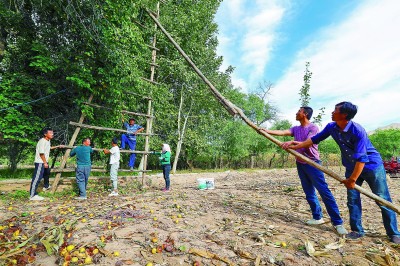
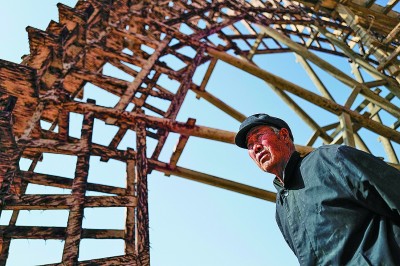
  Villagers set up big wooden ladders to pick pears.

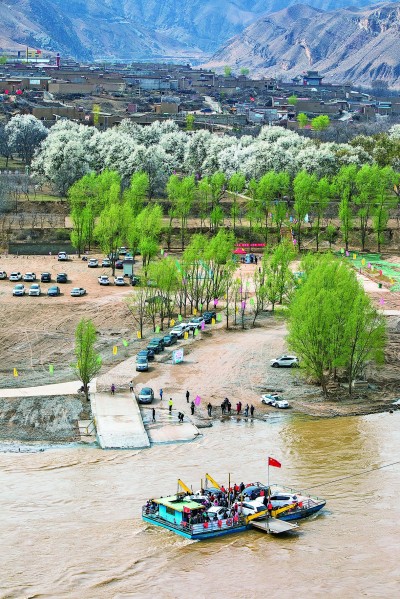
  Tourists driving private cars take ferry boats to the other side to enjoy the beautiful scenery of pear blossoms.

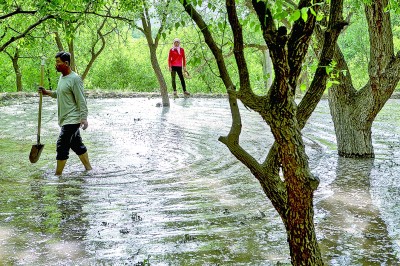
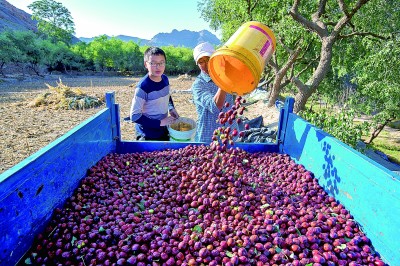
  A couple watered their fruit trees with Yellow River water.

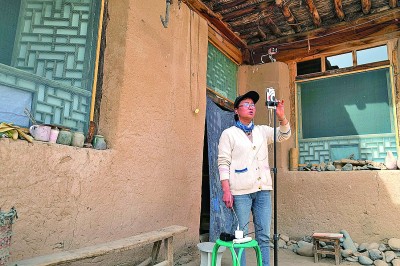
  The female homeowner who made a live tour promotion in front of the old house where the TV series Minning Town was filmed.

  Non-genetic inheritor who guards the Yellow River waterwheel all his life.

  Villagers who harvest buckets of red dates.

  Heishan Gorge is one of the most spectacular canyons in the upper reaches of the Yellow River, starting from Jingyuan in Gansu and ending at Zhongwei in Ningxia, with a total length of more than 70 kilometers. Black Mountain Gorge is named for its towering cliffs and deep rivers, because the exposed rocks in the canyon are mostly blue-black. The Great Wall, built along the steep cliff on the bank of the Yellow River, stretches in thousands of valleys, and there are stone walls, rammed earth walls, beacon towers, closed castles and so on. The cultural heritage of the Yellow River and the Great Wall has created a magnificent, simple and profound Black Mountain Gorge.

  In recent years, I have been going deep into da miao cun, Jingyuan County, Gansu Province, Cui Liu Cun, Jingtai County, and Nanchangtan Village and Beichangtan Village, shapotou district, zhongwei, Ningxia, telling the scenery and stories of Heishanxia with the lens, freezing the life moments of spring and summer, autumn harvest and winter storage, and recording the changes of the times in poverty alleviation and rural revitalization, so as to express my deep feelings and cultural concerns about the Yellow River and the Great Wall.

  One side of the soil and water support one side of the people, relying on the nourishment of the Yellow River water. Several traditional villages scattered in the depths of the canyon are full of fireworks, like a secluded paradise. The waterwheel turning along the bank of the Yellow River and the pear blossoms blooming at the foot of the Great Wall have become the witness of people living along the Yellow River from generation to generation and living together with Heishan Gorge. People here stick to their simple and kind nature, follow the ancient life track, stay with the mountains and listen to the unchanging sound of the waves. They conscientiously inherited their ancestors’ business, raised sheep, farmed fields, and watered the fruit trees, creating a home where homesickness can be placed and the soul can live.

  Famous historical and cultural villages in China — — Nanchangtan Village, as the first village where the Yellow River flows through Ningxia, always draws my attention. Whether the lens focuses on the figures of people in the village, the face of the bride to be married in the boudoir, or the hands of the boatman, every moment is a "Yellow River story" with temperature. The change of a village, the persistence of a custom, and the creation of a farm tool … … Not only let us feel the distance and profundity of crossing historical time and space, but also let us realize the accumulation of the Yellow River culture.

  The Yellow River has been flowing forever. More than 80 years ago, Fan Changjiang, a famous journalist, crossed the Black Mountain Gorge on a sheepskin raft, and was shocked by the momentum here. In "Northwest Corner of China", he said with emotion: "The gorge is not less than the style of Wushan Gorge in the Three Gorges of the Yangtze River." Today, on both sides of the Yellow River, inside and outside the Great Wall, beautiful homeland is still our blood and soul. The unique natural landscape and rich humanistic customs of Heishanxia show the beauty of Chinese history, mountains and rivers, and culture, making the ancient villages along the coast famous far and wide, and more and more tourists are quietly changing here. Connecting roads, building new houses, promoting tourism, getting rid of poverty and tackling difficulties have enabled villagers to run towards a well-off life, and rural revitalization has given the village a new look. This land that has been silent for thousands of years has suddenly accelerated the pace of catching up with the times.

  Photography is a ferryman of time. I hope that in another 80 years, these pictures can still present a vivid picture of the lingering temperature in the historical context.

  (Author: Li Peng, member of China Photographers Association, executive president and secretary general of Ningxia Art Photography Society)

Academic circles respond intensively to gene editing babies: resolutely oppose strong condemnation

  Recently, scientist He Jiankui announced that the world’s first genetically edited baby immune to AIDS was born in China in November, which caused widespread doubts from all walks of life. On the 27th, the Ministry of Science and Technology, China Association for Science and Technology and China Academy of Sciences successively responded to the incident of gene editing baby: explicitly banned and resolutely opposed.

  Three departments responded to the gene editing baby incident

  On the 27th, in the "Minister’s Teahouse" held by the State Council Information Office, Xu Nanping, Vice Minister of Science and Technology, said that the Ethical Guiding Principles of Human Embryonic Stem Cell Research promulgated in 2003 stipulated that human embryos could be genetically edited and modified for research purposes, but the in vitro culture period should not exceed 14 days from fertilization or nuclear transfer. If this "genetically edited baby" is confirmed to have been born and is prohibited, it will be in accordance with the relevant laws and regulations of China.

  China Association for Science and Technology Life Science Association issued a statement on the 27th: stick to the bottom line of scientific research ethics, resolutely oppose illegal gene editing of babies, and comprehensively investigate and punish the institutions involved.

  On 27th, the Scientific Ethics Construction Committee of China Academy of Sciences issued a statement on the official website of China Academy of Sciences, which mentioned, "We are highly concerned about this matter, and resolutely oppose any individual or unit to carry out the clinical application of human embryo gene editing under the circumstances of uncertain theory, imperfect technology, uncontrollable risks and explicit prohibition of ethical laws and regulations. We are willing to actively cooperate with the state and relevant departments and regions to conduct joint investigations to verify the relevant situation, and call on relevant investigation agencies to announce the progress and results of the investigation to the public in a timely manner. "

  122 scientists jointly strongly condemned.

  Immediately after the announcement of "Gene Editing Baby", many people questioned it. On that night, 122 China scholars issued a "Joint Statement of Scientists" through @ Intellectuals Official Weibo:"We, as biomedical researchers, resolutely oppose any attempt to edit the genetic genes of human embryos without strict ethical and safety review at this stage! ! ! Strongly condemn! ! !”

  Gene editing babies face multiple doubts

  At present, the academic and public doubts about genetically edited babies mainly focus on the following aspects:

  Question 1: Is it safe for two babies to knock out CCR5 gene?

  Question 2: Ethical and moral issues of this technology.. Hawking, a famous physicist, is worried that once there is a genetically modified Superman, the "unmodified human" may not be able to compete, gradually disappear, or become "unimportant", and human beings will compete for "self-design".

  Question 3: This technology can be done long ago without any innovation, but biomedical scientists around the world don’t do it or dare to do it because of the uncertainty of off-target, other great risks and more important ethics.

  Question 4: Why choose HIV? Is it to be famous or attract attention? Mother-to-child blocking technology of AIDS is very mature, so why choose gene editing?

  The baby event of gene editing continues to ferment, but He Jiankui himself has not responded to it. He is currently attending the second international summit of human genome editing in Hong Kong.

  He Jiankui once wrote that "gene editing is extremely irresponsible"

  Regarding the experiment of genetically modified babies announced by He Jiankui, the media noticed that in February last year, He Jiankui also published an article entitled "The Safety of Gene Editing of Human Embryos remains to be solved" on the blog of Science Network, in which he said: No matter from the perspective of science or social ethics, it is extremely irresponsible for any human to perform germ cell line editing or make gene editing until these important safety issues are solved.

  However, according to the time, just one year after he published this article, the human embryo of this genetically edited baby has been implanted into the human mother.

  In addition, on November 25, an Associated Press report on He Jiankui’s experiment also described this: An American scientist said that he participated in this work in China, and this kind of gene editing is prohibited in the United States, because changes in DNA will be passed on to future generations, which may harm other genes.

△ "News 1+1" video: Gene editing baby has become a fact?

  The reputation of China scientists in the field of gene editing may be affected.

  This incident is not the first time that China’s gene editing research has been questioned because of ethical issues. In April 2015, Huang Jun, a professor at Sun Yat-sen University, reported in a study published online in the biological magazine protein and Cell that his team had completed the world’s first gene modification experiment in human embryos. Huang Jun originally hoped to publish this research in the journal Nature or Science, but was rejected successively. The two magazines refused to disclose the details of the review, but admitted that they were concerned about the complex ethical issues behind human gene editing.

  At that time, just before the first international summit on human genome editing, the summit finally issued a statement, which gave a green light for studying the modification of early human embryos or germ cells by gene editing technology, but at the same time pointed out that the modified germ cells should not be used for pregnancy purposes. Since then, China’s ethical principles of genetic science have been strictly examined by international academic circles.

  Three years ago, many China scientists stood on the side of Huang Jun. Zhai Xiaomei, executive director of Bioethics Research Center of China Academy of Medical Sciences and professor of Peking Union Medical College, was one of them. She said that Huang Jun’s experiment belongs to pre-research, and "no clinical trial at all" is to deepen the understanding of technical knowledge. The team used the three embryonic nuclei abandoned by the hospital and could only survive for dozens of hours. National legal norms allow it, which is also in line with international bioethics norms. She has visited several countries to introduce the current situation of gene editing in China to international academic circles, and to eliminate "misunderstanding about Huang Jun’s experiment".

  At the 2nd International Summit of Human Genome Editors held on 27th, Zhai Xiaomei originally planned to introduce the development of bioethics in China, in response to the international community’s doubts about China. But the news of the birth of a genetically edited baby the day before the meeting made her feel a blow.

  In Zhai Xiaomei’s view, the nature of He Jiankui’s experiment is completely different from that of Huang Jun. "It is academic anomie and there is a big problem." She said, "it’s too much to report to the academic community after the children are born!" Moreover, the existing laws and regulations in our country prohibit this. "

  In 2003, the Ministry of Science and Technology and the Ministry of Health jointly issued 12 "Ethical Guiding Principles for Human Embryonic Stem Cell Research", among which Article 6 stipulates that "human blastocysts that have been used for research shall not be implanted into the reproductive system of human beings or other animals." In He’s experiment, genetically modified embryos were put into the uterus and gave birth to twins.

  Netizen: Pandora’s Box has been opened.

  This matter has also caused a large-scale discussion among netizens on the Internet. The following is a message from CCTV news users ↓ ↓

  @ Let it be: Support the Ministry of Science and Technology to respond! Resolutely oppose the clinical application of human embryo gene editing, which is prohibited by ethical laws and regulations!

  @ lobangwangmu: Scientific research really needs to be based on ethics and law. Science and technology without moral and legal foundation may bring not happiness but disaster to mankind! Support the response of the Ministry of Science and Technology!

  @ 京京京京: The super human predicted by Hawking, Pandora’s box has been opened.

  @ 京京京京京: Don’t do research that violates ethics! That is worthless and a waste of manpower and capital.

  @ 京京京京京 Joanna: If human beings start the gene editing mode, there will be more genetic changes in the future, which will violate the principle of nature’s survival of the fittest and natural selection.

  @ Daying: This is a simple and rude experiment. A single gene can immunize against many diseases, even single-celled organisms do not, and gene knockout will have unpredictable chain reactions in vitro. This congratulation not only challenges ethics, but also is unscientific, and the experiment is not innovative. It just treats people as guinea pigs, which makes the international community distrust the scientific community in China and has a serious negative impact.

  @YUE: The progress of science and technology is supposed to be a good thing, and it is beneficial to mankind. Gene editing can solve some problems that cannot be solved by current medicine from the source, but once it is out of the bondage of law and driven by interests, the achievements of science and technology will easily be used by bad people and bring disaster to mankind. Therefore, at the same time of scientific and technological progress, we should constantly standardize the relevant legal system and strictly enforce it so that the achievements of scientific and technological progress can contribute to human progress.

  @ mr.yao: Support not to edit genes casually. If this can be edited casually, it is a potential threat to the natural development of mankind.

The movie "Charles IX" issued a new poster to create a new world of summer adventure.

Poster of the movie "Charles IX" and "Conquering Atlantis"

Poster of the movie "Charles IX" and "Conquering Atlantis"


Today, Charles IX, the first fantasy film for teenagers in China, released a poster of "Conquering Atlantis", dedicated to every curious, brave, companion and dreamy teenager. In the poster, four post-05 teenagers and Charlie, the boss of the dog industry, teamed up to explore in different adventure scenes, showing an adventurous state of being fearless and United. At the same time, this poster also shows the key special effects scenes in the film by hand for the first time, which makes people daydream.


The film is adapted from the best-selling book "Everyone after 00", directed by Wang Jing, a director with high reputation in Chinese, and combined with the young fresh face after 05 and the powerful adult actor Qin Hao. The film has been confirmed to be released nationwide on July 13th this summer.


Hand-painted posters of teenagers conquering Atlantis show special effects.  


The theme of this poster is "Conquering Atlantis", and the four declarations of "curiosity, partnership, fearlessness and dreams" convey the temperament of the four post-05 heroes "no adventure, many years". "Atlantis", as a classic scene of the original novel, is a continent that gave birth to prehistoric civilization and was destroyed by floods. It is not only the adventure holy land that the four protagonists have been longing for for for a long time, but also the code name of this adventure. In the poster, the seemingly weak bodies of four teenagers are in stark contrast to the actions across dangerous situations; By organizing a delegation to the 408 base, they have overcome the dangers of climbing towers, tunnel adventure, dam escape, weightlessness and falling. Combined with the different copywriting in each poster, it pays tribute to the brave young heart and the courage to walk side by side, which resonates with many viewers who also have adventure dreams.


For the first time, the poster shows many impressive special effects scenes and internal details, such as the entrance to another world, the abyss tunnel, the underground dam, the weightless space and so on, by hand drawing, and constructs a mysterious and imaginative fantasy world. It is also expected how the real effects of these special effects scenes will be presented in the end.


It is worth noting that there are many details of "thinking carefully and fearing" buried in the poster. For example, in the poster of "Climbing the Tower", a figure is secretly following four teenagers. What is his identity? In the poster of "Dam Escape", who are the vague figures around the protagonists and why do these people appear in 408? And how do those enlarged and mutated butterflies exist in the film? These details also triggered many speculations about the plot.


Poster of the movie "Charles IX" and "Conquering Atlantis"


Poster of the movie "Charles IX" and "Conquering Atlantis"


After 00, the representative best-selling books first appeared on the screen, and their unique temperament was highly anticipated.


Previously, foreign teenagers’ adventure fantasy works, such as Harry Potter and The Hunger Games, have achieved good market and word-of-mouth results. Charles IX, as the "water tester" of this kind of theme in China, received strong feedback from the audience as soon as it was released. In the poll "Which summer movie would you buy a ticket to see" initiated by a high-traffic platform where some young people gathered, Charles IX was also among the best.


In order to better create a fantasy adventure world belonging to China teenagers, the film has made great efforts in terms of director, shooting location and special effects. In terms of directing, the film is directed by Wang Jing, a high-profile director who is good at realistic themes, which avoids the risk of the film becoming younger and improves the overall quality and expectation of the work. In terms of shooting location, in order to make the shooting location realistic, the scenery team spent two months in Yumen, Gansu Province, recreating the northwest town in the 1990 s and the mysterious scientific research base in the film; On the scene setting site, the crew also set scenes in Gansu, Qinghai and Beijing to build a scene design that meets the requirements; In terms of special effects, Charles IX has nearly 2,000 special effects shots, accounting for more than half of the film’s duration.


The film Charles IX is the first fantasy film for teenagers in China, which will be released on July 13th. This summer, let’s look forward to "Charles IX" to arouse our adventurous youth!


The Ministry of Foreign Affairs answered questions on the cancellation of tariffs between China and the United States.

On November 8, 2019, Foreign Ministry Spokesperson Geng Shuang held a regular press conference

At the invitation of France, Wang Qishan, Vice President of the People’s Republic of China will go to France to attend the second Paris Peace Forum from November 11th to 13th.

France is a permanent member of the United Nations Security Council and a core power of the European Union. In recent years, Sino-French relations have developed in a sustained, healthy and stable manner, with close high-level exchanges between the two countries, increasing political mutual trust and continuous achievements in pragmatic cooperation in various fields. This year marks the 55th anniversary of the establishment of diplomatic relations between China and France. The Chairman of the Supreme Leader and President Macron successfully exchanged visits during the year and reached a series of new strategic consensus. Vice President Wang Qishan attended the second Paris Peace Forum on behalf of China shortly after President Macron’s visit to China, which reflected the high quality and level of current Sino-French relations. China is willing to work with France to continue to strengthen strategic communication, deepen pragmatic cooperation, thoroughly implement the consensus of the two heads of state, and push China-France comprehensive strategic partnership to a new level.

Q: About the South China Sea in China. This week, a senior Vietnamese official said that he hoped to resolve the South China Sea dispute with China through legal channels. Has Vietnam discussed this matter with China? If so, how did China respond?

A:The core of the South China Sea issue is the territorial issue arising from Vietnamese and other countries’ occupation of relevant islands and reefs in Nansha Islands of China. It is hoped that Vietnam will face up to historical facts, abide by the high-level consensus between the two countries, persist in resolving differences through dialogue and consultation, and avoid taking actions that may complicate relevant issues and interfere with peace and stability in the South China Sea and the overall situation of bilateral relations.

Q: On the 7th, during her visit to Germany, US Secretary of State Pompeo said that considering the challenges brought by the Communist Party of China (CPC), the construction of telecommunication network in Germany has become very complicated. Earlier, Pompeo said in an interview with the media that we should ensure that all countries in the world understand the risks related to the Communist Party of China (CPC) and the consequences of our long-term tolerance. What’s your comment on this?

A:Pompeo’s attacks discredit China’s political system, exaggerate the so-called China threat, and are full of ideological prejudice and cold war zero-sum game thinking. China expresses strong dissatisfaction and resolute opposition.

Pompeo separated the people of China from the Communist Party of China (CPC) in an attempt to sow discord between the people of China and the Communist Party of China (CPC). I can tell him clearly that the Communist Party of China (CPC), the ruling party in China, has always represented and firmly safeguarded the interests of the people of China in the struggle for nearly a hundred years, and has won the deep trust and heartfelt support of the people of China. The words and deeds of trying to separate the people of China and the Communist Party of China (CPC) are a provocation to all the people of China and are doomed to fail.

It must be pointed out that Pompeo’s remarks are very dangerous, which is seriously inconsistent with his status as US Secretary of State, and fully exposes his sinister intention of trying to gain personal political capital through anti-China.

We advise him to stop nagging at China for no reason, lest he shoot himself in the foot.

Q: First, the United States has not made a public response to the statement made by China’s Ministry of Commerce yesterday on the cancellation of tariffs between China and the United States. Have the two sides really reached an agreement on this? It seems that the United States still hesitates on this issue. Some American officials accused China of trying to renegotiate the first-stage agreement for its own benefit, while the United States had only agreed to cancel those tariffs that had not yet been imposed. Second, what is China’s concern about the time and place of signing the agreement on the first stage of economic and trade consultation? U.S. Secretary of State Pompeo hinted that the U.S. side will hold an informal APEC leaders’ meeting in January next year, when an agreement will be signed with China. Even so, the signing of the agreement between the two countries during the APEC meeting in Chile was postponed. What’s your comment on this?

A:Regarding your questions, especially the cancellation of tariffs between China and the United States, at the press conference of the Ministry of Commerce yesterday, the spokesman of the Ministry of Commerce gave a comprehensive and full response. I have nothing to add here.

Q: As usual, during the BRICS leaders’ meeting, all parties will hold BRICS+related activities. However, there seems to be no relevant arrangement during the upcoming BRICS leaders’ meeting in Brazil this year. Does the Ministry of Foreign Affairs know the specific reasons? Does this mean that the BRICS countries have lost an opportunity to enhance relations with Latin America?

A:Since its inception, the BRICS mechanism has been closely linked with the fate of emerging markets and developing countries. Strengthening cooperation with other developing countries is the responsibility of BRICS countries as emerging powers, and it is also a fine tradition that we have always adhered to. In 2017, China initiated the "BRIC+"model and held the "Dialogue between Emerging Market Countries and Developing Countries" during the meeting of BRICS leaders in Xiamen. For the first time, it invited guest countries from all over the world to attend the meeting, which was highly praised by all parties. Last year, South Africa continued this practice and continued to hold the BRICS+Leaders’ Dialogue during the Johannesburg meeting, which achieved positive results. This year, we continued the "BRIC+"model in many activities and invited some representatives from emerging markets and developing countries to participate, further expanding the "circle of friends" of BRICS countries and promoting the common development of all countries.

China respects the decision of the BRICS Chairman not to hold the BRICS+Leaders’ Dialogue during the meeting in Brasilia this year.

Q: Ask a question about APEC. It is reported that the United States is considering holding an APEC meeting in January next year after Chile canceled the APEC meeting. What is China’s attitude towards this?

A:Regarding what you asked, we have been keeping in touch with all parties concerned to understand the situation. As a matter of principle, we believe that when it comes to APEC matters, we should respect the opinions of the host and follow the principle of consensus.

Q: Today, Japanese local councillor Sakuragi was sentenced to life imprisonment by the China court. What is China’s comment on this?

A:Today, the Intermediate People’s Court of Guangzhou City, Guangdong Province issued a public verdict on the drug smuggling case according to law, among which a Japanese citizen Sakuragi pondered. On October 31, 2013, when he was preparing to take a flight back to Japan via Shanghai at Guangzhou Baiyun International Airport, the security personnel seized methamphetamine, commonly known as ice, in the interlayer of the suitcase tie rod and the women’s muffin sandals in the box, with 3289 grams. According to the laws of China, the Guangzhou Intermediate People’s Court sentenced Sakuragi to life imprisonment and confiscated all personal property. The court has released news on this.

I should add that China has informed the Japanese Consulate General in Guangzhou about this case.

****************************

Not long ago, we solemnly celebrated the 70th birthday of People’s Republic of China (PRC). Today, we celebrate the 70th anniversary of the establishment of the Ministry of Foreign Affairs of People’s Republic of China (PRC). Seventy years ago today, on November 8, 1949, the inaugural meeting of the Ministry of Foreign Affairs was held in Beijing. Premier Zhou Enlai, who was also Foreign Minister at that time, attended the meeting and made an important speech.

Looking back on the past 70 years, under the strong leadership of the Communist Party of China (CPC), China’s diplomacy has gone through a magnificent course, written magnificent chapters, achieved fruitful results that have attracted worldwide attention, and won support and respect at home and abroad.

Over the past 70 years, China’s diplomacy has firmly defended national sovereignty, security and development interests, actively served the process of reform and opening up, fully practiced the concept of "diplomacy for the people", continuously promoted the great cause of world peace and development, profoundly changed the relationship between China and the world, significantly enhanced China’s international status and created a favorable external environment for national development.

Standing at a new historical starting point, China’s diplomacy as a big country with characteristics will be guided by the diplomatic thought of the supreme leader, continue to hold high the banner of peace, development, cooperation and win-win, persist in building a global partnership, actively participate in global governance, and make new contributions to realizing the Chinese nation’s great rejuvenation of the Chinese dream and promoting the building of a community of human destiny.

****************************

Today is China Journalists’ Day. Here, I would like to wish all China journalists and foreign journalists who work and live in China a happy holiday!

I would also like to take this opportunity to express my heartfelt thanks to all of you for your long-term attention and reports on the diplomacy of China and China, and for your participation and support in the regular press conference of the Ministry of Foreign Affairs.

We look forward to continuing to maintain close communication and cooperation with you!

I wish you all a happy holiday!

The M8 spy photos are exposed, and the pre-sale price is 350,000-450,000.

Automobile technology I yuma technology

It is understood that the M8, the latest model of AITO, has completed a number of tests at the end of 2024, including winter tests; Its camouflage-free real car map is also officially exposed, and it is expected to become one of the most competitive new energy SUVs next year.

According to this, some bloggers have produced the latest renderings. From the appearance, Wenjie M8 continues the design style of Wenjie family, and the front face is designed with wings folded up and down.

The top of the car is equipped with chrome trim, and there is an ultra-fine daytime running light strip under the trim, which cooperates with the digital smart headlights below.The world of "Technology Car King" is very similar to M9. Some netizens commented that the car is a scaled-down version of the M9.

Compared with the boundary M9, the body size of the boundary M8 is obviously smaller, and the length is expected to be about 5 meters. The car will adopt a "star-picking" door handle that is consistent with the Zunjie S800, but this design did not appear on the Wenjie M9 model.

In the tail design, the tail shape of Wenjie M8 is slightly different from that of M9, mainly reflected in the lamp design, which is also flat on the top and folded down, with chrome-plated strips above and red outline lights below.

In terms of power, it is expected that the M8 will provide two versions of extended range power and pure electric power, and the specific configuration is very close to that of the M9, including 800V high-voltage fast charging, Huawei Gankun Intelligent Driving ADS 3.2 system, Turing chassis and other black technologies.

It is worth noting that the official has not disclosed the details of the interior of the car, but according to the spy photos of the camouflage road test, the interior layout is very close to the M9, and it is also a "three-screen" design, and it is expected to be equipped with dual mobile phone charging panels.

Others, such as zero-gravity seats, HUAWEI SOUND audio system and HarmonyOS cockpit, will also become the standard of the M8.

In addition, it is expected to be officially released in the first half of 2025, and the price is between 350,000 and 450,000 yuan, aiming at filling the market gap of the brand in this price range.

It is widely expected in the market that in the fierce competition with Huawei, with its intelligent configuration and Huawei’s brand effect, the M8 will become an explosive model in the price range of 350,000-450,000 yuan.

In a word, there are many similarities with M9 in appearance design, but it also shows obvious characteristics in details, which is more compact as a whole and competitive in configuration and price.

The five-star red flag shines on China and greets the grand event with one heart and one mind.

  Cctv news(News Network): The people have faith, the country has strength and the nation has hope. General Secretary of the Supreme Leader pointed out: "To realize the Chinese dream, we must carry forward the spirit of China. This is the national spirit with patriotism as the core and the spirit of the times with reform and innovation as the core. This spirit is the soul of rejuvenating the country and the soul of a strong country. "

  Since the 18th National Congress of the Communist Party of China, under the strong leadership of the CPC Central Committee with the Supreme Leader as the core, the cause of the party and the country has made historic achievements and undergone historic changes. The banner of patriotism has always been flying high in the great journey of the new era and in the hearts of every China person.

  今天(10月1日),北京天安门广场举行庄严隆重的升国旗仪式,超过二十万名各界群众现场感受爱国热情、家国情怀。在新中国迎来73华诞之际,从边关海岛到城市乡村、从鱼米之乡到雪域高原,鲜艳的五星红旗迎着清晨第一缕阳光在神州大地冉冉升起,全体中华儿女共祝祖国更美好。

  金秋十月的北京,天安门广场流光溢彩,喜庆祥和。“祝福祖国”巨型花果篮伫立广场中央,二十多万各界群众昂首肃立,静候期待庄严时刻。

  今天,迎着第一缕阳光,五星红旗在神州大地冉冉升起。从祖国东端的黑龙江抚远到南端的海南三沙,从边关海岛到雪域高原,人们举行庄严的升国旗仪式,庆祝新中国成立73周年,喜迎党的二十大胜利召开。

  同升一面旗,共祝祖国好。在革命老区甘肃华池、宁夏盐池,在江西瑞金、福建龙岩等原中央苏区,人们在国旗映照下,赓续红色血脉,汲取奋进力量。

  这个国庆节,大江南北的一座座县城、一个个乡村,五星红旗迎风招展。在内蒙古乌审旗、云南陇川县,过上幸福小康生活的各族群众升国旗、唱国歌;在浙江安吉余村、广西象州花池村、贵州赤水五星苗寨、新疆和田阿依丁库勒村,奔忙在乡村振兴一线的人们深情祝福祖国,礼赞伟大时代。

  Today, people from all walks of life raise the national flag to unite the majestic struggle force for building a socialist modern country in an all-round way. The builders of the R1 line of xiong’an new area-Beijing Daxing International Airport held a flag-raising ceremony at the construction site. Port workers in Shanghai Yangshan Deepwater Port Area look at the national flag and sing the national anthem.

  In Luding County, Sichuan Province, more than 1,400 people affected by the disaster have all moved into centralized transitional resettlement sites, and the flying five-star red flag gathers people’s confidence and strength in building their homes.

  Today, all the troops of the whole army held a grand flag-raising ceremony. The officers and men solemnly saluted the five-star red flag, expressing their blessings to the great motherland and their firm determination to strive for a strong army.

  Today, the Government of the Hong Kong Special Administrative Region held a flag-raising ceremony at Golden Bauhinia Square to celebrate the 73rd anniversary of the founding of People’s Republic of China (PRC). The bright five-star red flag and the regional flag of the Hong Kong Special Administrative Region are raised in Golden Bauhinia Square; After that, helicopters flew over Victoria Harbour to display the national flag and regional flag. The ship saluted by spraying water column on the sea surface.

  The government of the Macao Special Administrative Region also held a flag-raising ceremony at the Golden Lotus Square today. With the national anthem played, the audience stood still and watched the five-star red flag and the Ran Ran, the regional flag of the Macao Special Administrative Region, rise. Many Macao citizens and tourists have taken photos in the square as a souvenir.